Answers without the ticket
Business users self-serve in natural language, analysts go faster, and every answer stays grounded in the governed semantic layer — for your team and your customers.




 and 50+
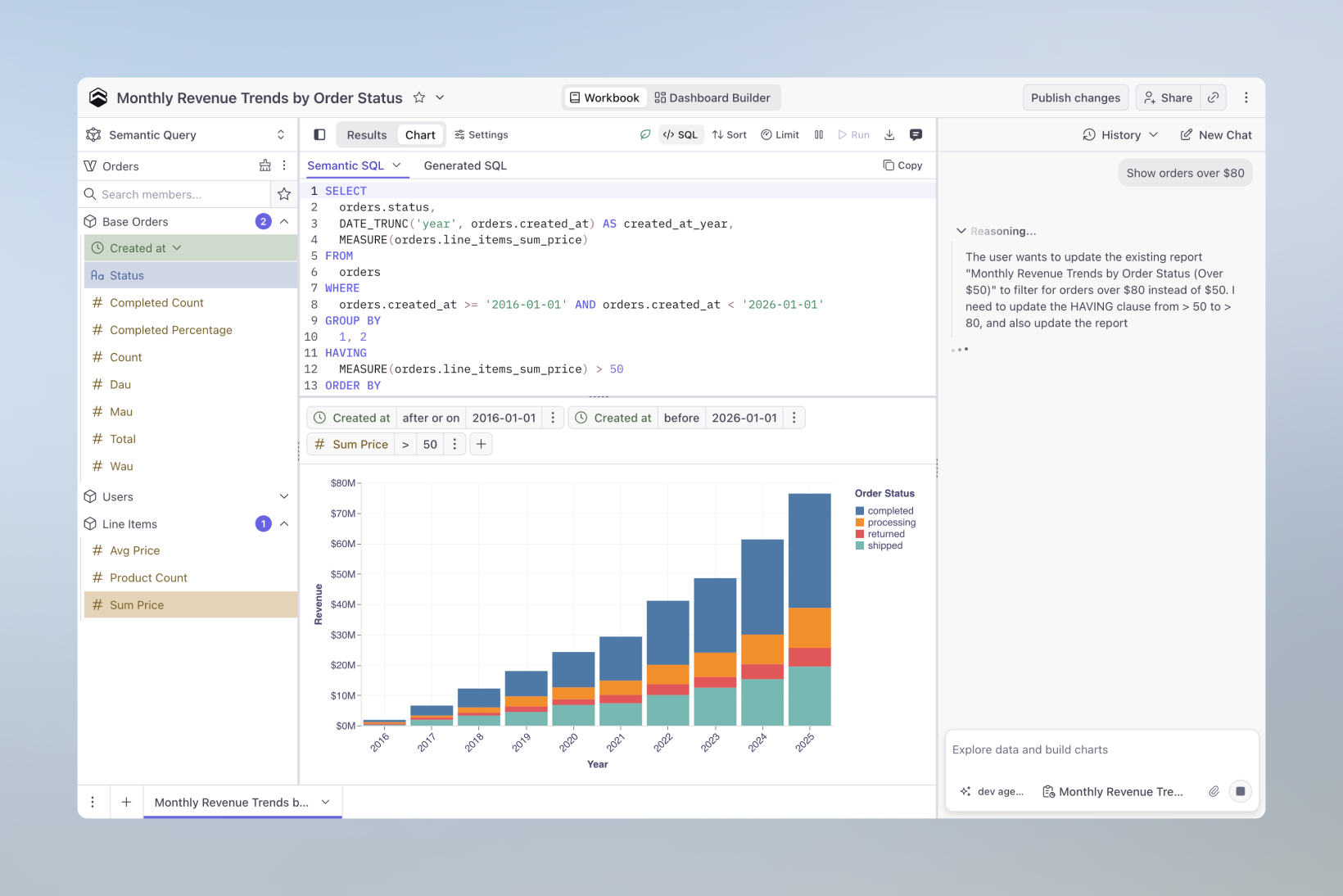
Explore in a workbook, with an AI analyst beside you
- Ask the Workbook AgentDescribe the analysis and the agent drafts the query, chart, or report — while you keep control of every field, filter, and label.
- Three ways to queryStart in natural language, then drop into point-and-click, raw SQL, or Semantic SQL on governed metrics when you want more depth.
- Governed by constructionEvery chart is backed by a reusable, governed report, so an ad-hoc exploration stays consistent with the rest of your analytics.
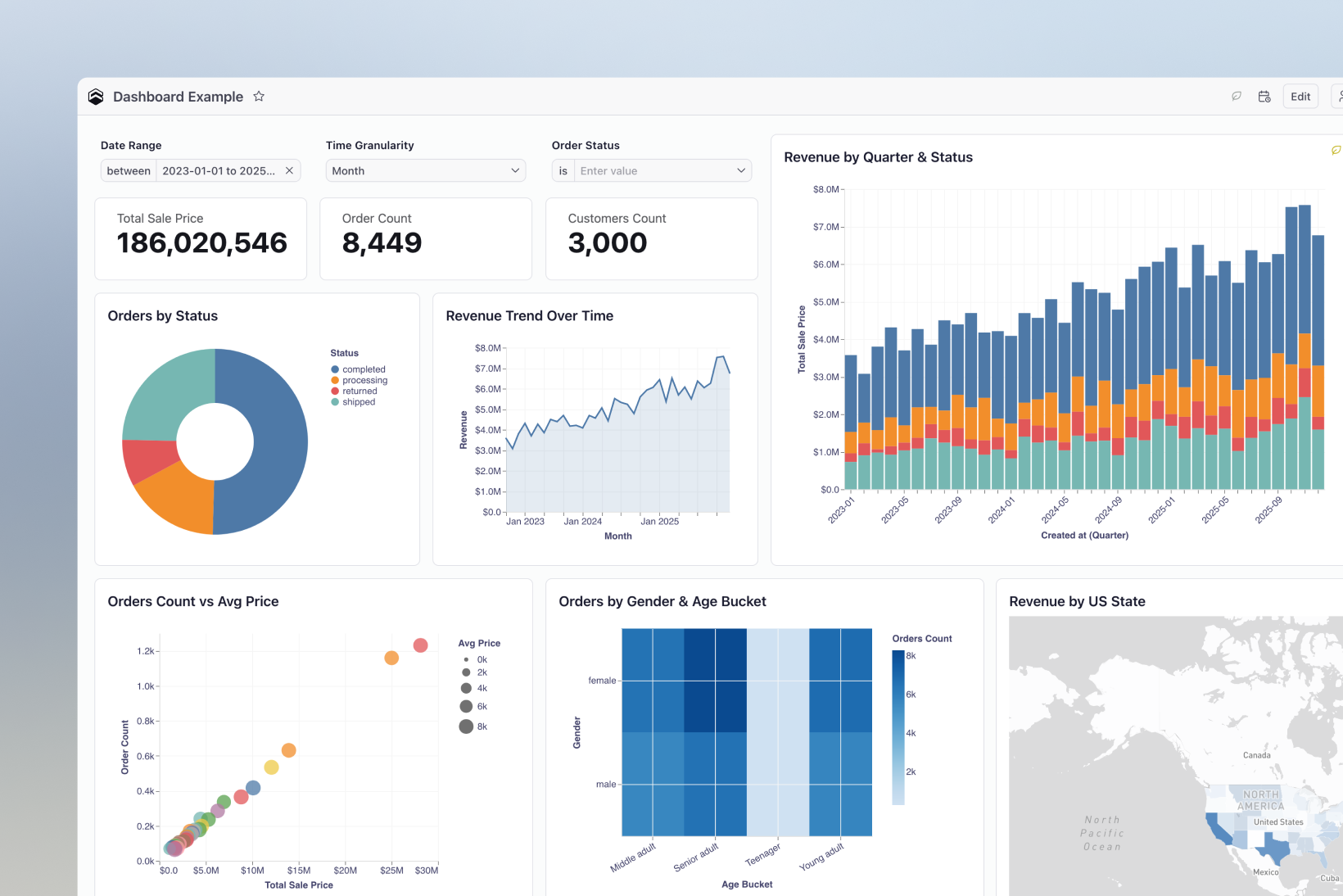
Drill into a dashboard by asking
- Ask the Dashboard AgentBreak a metric down, extend the range, or ask what a definition means — a follow-up, not a new ticket, on the same governed model.
- Every widget you needChart, KPI, filter, time-grain, text, and AI Summary widgets, arranged the way your team reads them.
- Self-serve, then shareScheduled refreshes, PNG and PDF snapshots, and embed-anywhere — so the answer reaches whoever needs it.
Explore where you already work
- In CubeAnalytics Chat, workbooks, and dashboards — explore, build, and publish without leaving the platform.
- In your AI toolsQuery the governed model from Claude, ChatGPT, or an agent you build, each connected over MCP.
- In SlackDrop the Slack Agent into a thread and follow up where your team already talks — permissions carry through.
Brex grounds its embedded agentic analytics on Cube's governed model, so answers stay consistent and scoped to each customer. Brex chose Cube over the dbt Semantic Layer and LookML.Read the story
Teams exploring their data on Cube
“Cube becomes our single source of truth for metric definitions and powers everything from customer-facing dashboards to AI-driven quarterly business reviews. CSMs gain back dozens of hours each quarter, enabled by Cube’s semantic layer and agentic analytics.”

“We integrated Cube Cloud smoothly with ClickHouse, leveraging both for fast query execution while maintaining the abstraction needed for different teams to access data without diving into database-specific complexities.”
“Without Cube, our data analysts might have to write 20 different queries for a single core business metric. With Cube, that metric is defined once in the data model, and every downstream tool uses that definition along with the associated calculation logic.”