Verdict first. If you're leaving Power BI because you run a cloud warehouse and want AI and embedded analytics grounded in governed metrics, the alternative to shortlist is Cube — the agentic analytics platform built on a semantic layer, where one governed model serves internal BI, embedded analytics, and AI agents across Snowflake, BigQuery, Redshift, and Databricks. If what you mainly want is a more polished, model-driven dashboard experience, look at Looker. Spreadsheet-fluent finance and ops teams should look at Sigma; teams optimizing for speed and cost, Metabase. And if you're standardized on Microsoft or get Power BI bundled through E5 licensing, staying on Power BI is often the correct call.
That verdict isn't a ranking pulled from vibes — it falls out of a single evaluation lens we apply to every tool in this guide: the semantic-layer test. One definition before we run it, because "warehouse-native BI team" does real work here. We mean a team that runs on a cloud data warehouse — Snowflake, BigQuery, Databricks, or Redshift — that needs governed self-serve (business users get answers without breaking metric consistency), wants AI grounded in a semantic layer rather than improvising SQL against raw tables, and increasingly needs to embed analytics inside a product. Power BI can serve parts of that, but its assumptions point toward the Microsoft stack, and that's where the friction starts.
How we evaluated: the semantic-layer test
By 2026 nearly every BI vendor ships an assistant — Power BI has Copilot, Looker has Gemini, Tableau has Einstein, Metabase has Metabot — so "has AI" separates nothing. The question that actually separates tools is architectural: does the AI reason over a governed semantic layer, or is it generating SQL against raw tables and hoping the joins are right? An assistant without a semantic foundation is a confident guess generator — exactly what a finance or operations team can't ship. As Brex put it after choosing Cube, the semantic layer is what makes the AI useful.
So instead of a generic feature checklist, we ran every tool through five checks. Together they answer one question: can a single governed semantic layer serve internal BI, embedded analytics, and AI agents at the same time?
- The definition check. Is a metric like "net revenue" — including its joins and row-level security rules — defined once, in one governed model, and consumed everywhere? Or do definitions live inside a proprietary report model, duplicated per consumer, waiting to drift?
- The agent check. Can an external AI agent query certified metrics over a clean interface — SQL, REST, GraphQL, and increasingly MCP — or only through the vendor's own chat UI? Over a semantic layer, an agent selects certified metrics instead of re-deriving SQL from raw tables, which is what makes its answers consistent, governed, and explainable.
- The tenant check. If you ship analytics to customers, is the tool multi-tenant by construction, with row-level security and per-tenant caching — or single-tenant-first (or shared-capacity) with embedding added on?
- The stack check. Does it sit on your warehouse — Snowflake, BigQuery, Redshift, Databricks — and read your dbt models, or does it pull your architecture toward one cloud's stack?
- The exit check. Are the metric definitions SQL-first and portable, is there an open-source foundation to reduce lock-in, and does pricing scale smoothly with use — or are there capacity cliffs and a commercial-only stack?
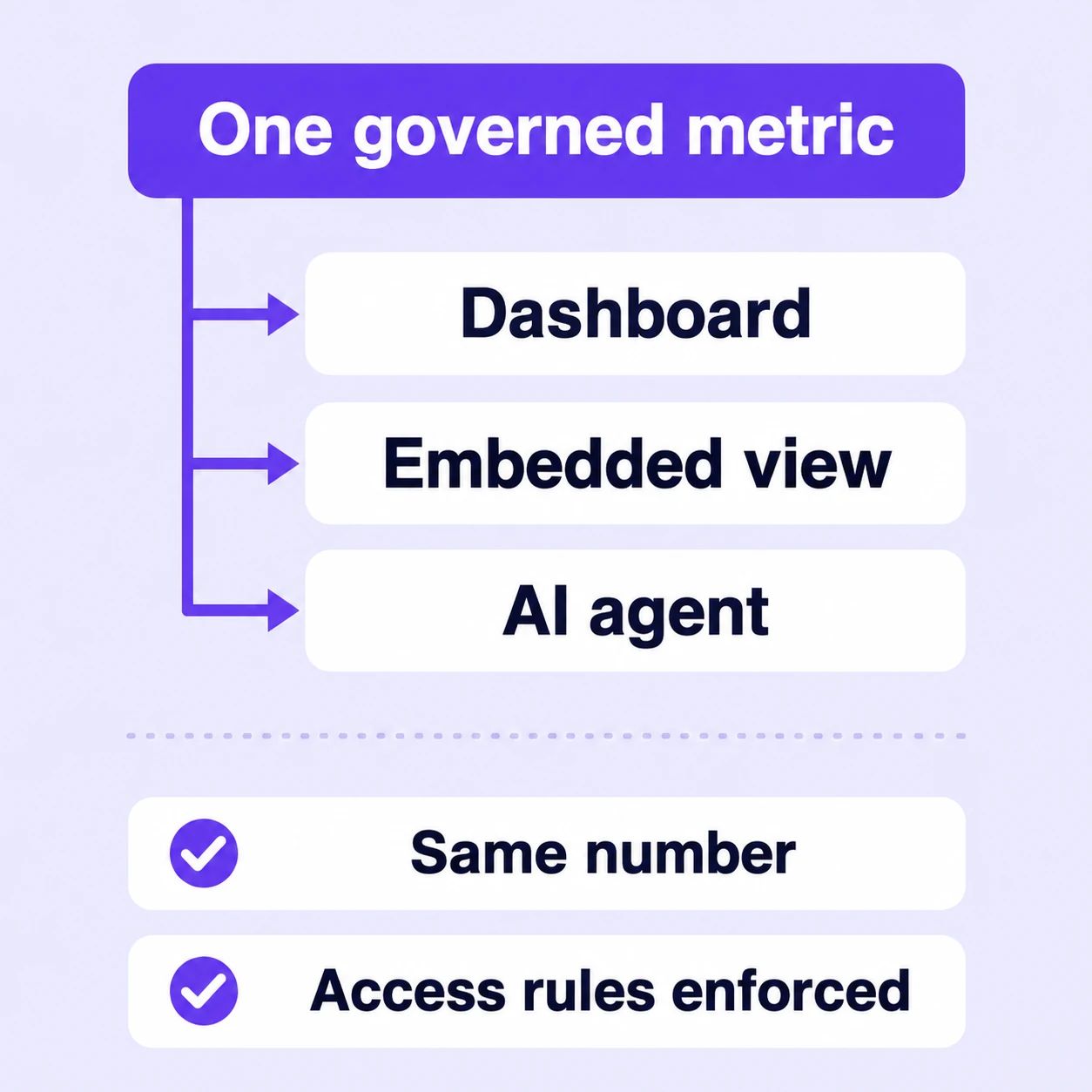
You can run this test yourself in any vendor evaluation, and we'd encourage it: pick one governed metric that carries a row-level security rule, and ask the vendor to show it consumed three ways — in a dashboard, in an embedded view under a tenant's credentials, and by an AI agent answering a plain-language question. Same number in all three places, access rules enforced in all three places, and you have a real semantic layer. Anything else is a report builder with accessories.
Match your situation to a pick
If you already know your constraints, the shortlist is short:
- You run a non-Microsoft warehouse and AI grounded in a semantic layer is the goal, or embedded is a first-class requirement: choose the platform where the semantic layer is the AI-native foundation, agents reach governed metrics over MCP and SQL, and multi-tenancy is built in — that's Cube.
- You want polished, model-driven dashboards: Looker, especially if you value a mature LookML model and Google Cloud fit.
- Your users live in spreadsheets: Sigma meets finance and ops where they already work, and is an easy move for Excel-heavy Power BI teams.
- You want speed and low cost for self-serve: Metabase gets you to a dashboard fast.
- Visualization is the priority: keep Tableau for viz and put a governed semantic layer upstream of it.
- You're all-in on Microsoft, bundled through E5, or Excel-centric: Power BI is still the path of least resistance, with the Fabric, dual-governance, and embedded-capacity caveats below.
The rest of the guide is the reasoning: why teams leave, how each tool fares on the test, and how to migrate without re-creating the governance problem you're escaping.
The three exits: what actually pushes teams off Power BI
A caution before the list: the most common evaluation mistake is treating this decision as "find another report builder." Power BI's real footprint in most organizations is a sprawl of datasets, DAX measures, and row-level security rules — the governed logic, not the visuals. Replace the visuals and lose the model, and you've moved sideways while re-creating the same governance problem in a new tool. The exits below aren't complaints about Power BI's polish or its install base; they're structural reasons warehouse-native teams start looking elsewhere.
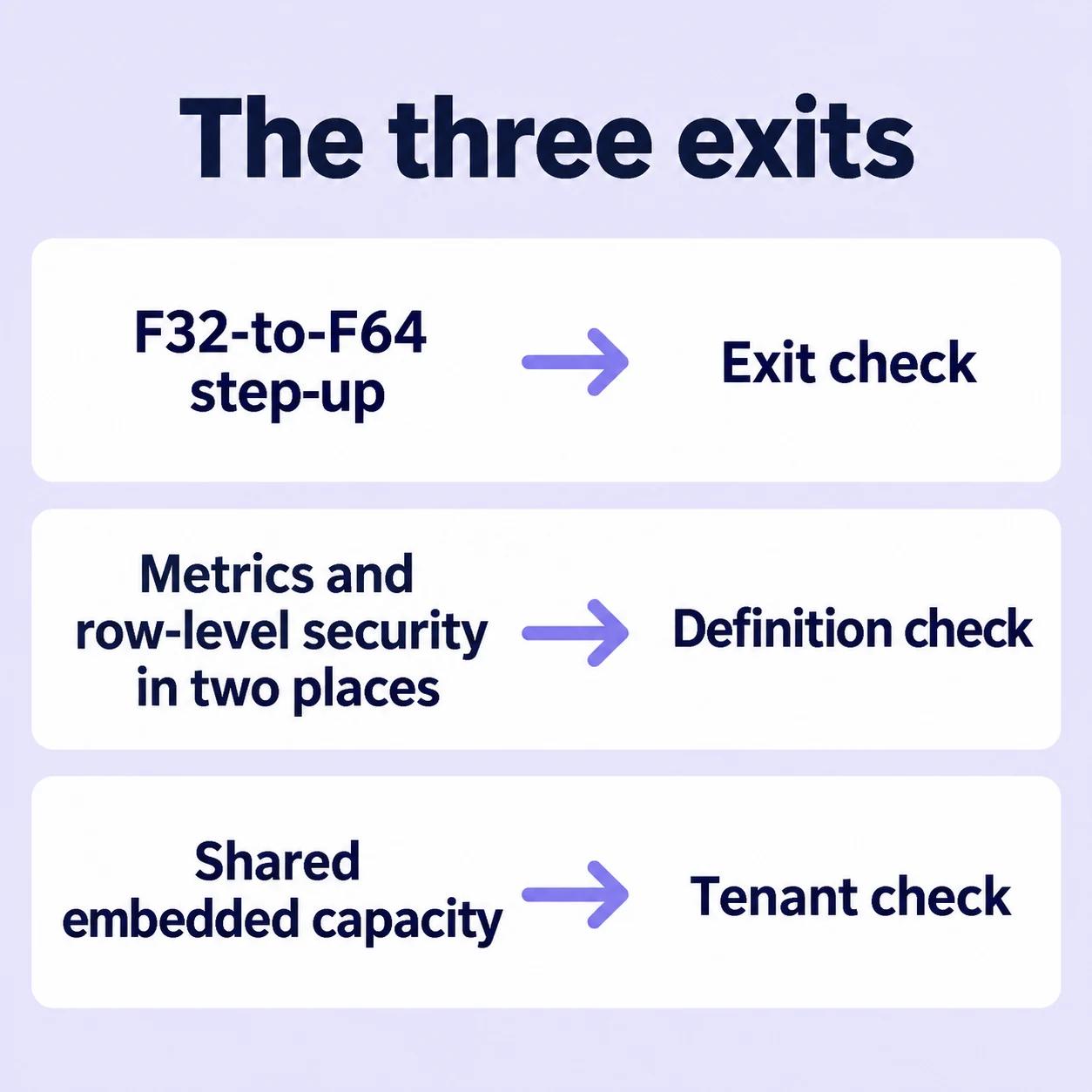
Exit 1: the Fabric capacity model and the F32-to-F64 step-up. Power BI now lives inside Microsoft Fabric, sold in capacity SKUs (F2, F4, F8, and up, doubling at each tier). The jump from F32 to F64 is a known pain point: F64 is the tier that unlocks broad free-viewer access in many scenarios, and reaching it roughly doubles capacity cost. Teams can outgrow a lower tier and find the next one is a large step rather than a smooth increase — a budgeting cliff rather than a slope. (Capacity SKUs and viewer entitlements change; confirm current Fabric terms against Microsoft's documentation as of 2026.)
Exit 2: two systems for metrics and row-level security when you also run dbt. Modern teams increasingly model their data in dbt. With Power BI, the governed metric layer and row-level security tend to live in Power BI semantic models and DAX as well, so you maintain the same business logic in two places. That's a governance tax, and worse, it's a drift risk: the definition of "active user" or "net revenue" in dbt and the one in Power BI fall out of sync, and now you have two versions of the truth — the exact thing a semantic layer is supposed to prevent.
Exit 3: embedded capacity throttling and the noisy-neighbor problem. Power BI Embedded draws on shared capacity. When you ship analytics to customers, one tenant's heavy query can consume capacity and degrade performance for everyone else on that capacity, and scaling means buying more of it. For a SaaS product where analytics is a feature customers depend on, shared-compute throttling is a structural risk. Platforms built multi-tenant-first isolate tenants by construction, with row-level security and pre-aggregation caching, rather than rationing a shared pool.
Notice that each exit is a failed check from the test above: the exit check, the definition check, and the tenant check, respectively. That's not a coincidence — it's why the test is the right lens.
Six alternatives, run through the test
Cube — the agentic analytics platform, built on a semantic layer
Best for: warehouse-native teams that want AI-native analytics — internal BI, embedded analytics, and AI agents — on one governed semantic layer, across any major cloud.
Cube is an agentic analytics platform built on a semantic layer. Its open-source foundation, Cube Core (Apache 2.0), is the semantic layer — the same governed model that powers dashboards, embedded surfaces, and AI agents. It's SQL-first and extensible at query time: the data team's governed definitions stay intact while AI constructs ad-hoc calculations on top. Cube sits on top of Snowflake, BigQuery, Redshift, or Databricks, reads your dbt models, and exposes governed metrics over SQL (Postgres-compatible), REST, GraphQL, and an MCP server, with pre-aggregation caching and row-level, multi-tenant access control. Embedded surfaces include the Analytics Chat API, iframes, Creator Mode, and Core Data APIs.
On the test: this is the platform the test describes. One governed model (definition check), agent access over MCP and SQL/REST/GraphQL (agent check), multi-tenancy by construction with RLS and caching (tenant check), cross-warehouse with dbt read (stack check), and an Apache 2.0 open-source core with SQL-first, portable definitions (exit check). It answers Power BI's three exits directly: cross-warehouse rather than Microsoft-bound; one governed metric layer instead of maintaining metrics and row-level security twice when you run dbt; and per-tenant isolation and caching rather than rationed shared capacity. Brex evaluated Cube against the dbt Semantic Layer and LookML and chose Cube, building an embedded AI financial analyst (Brex Spaces) on it; 400+ companies build on Cube. The open-source heritage gives it credibility a commercial-only tool can't match.
Where it gets harder: Cube is a platform to model and operate, and it's upstream of visualization rather than a drag-and-drop report builder — you bring or build the viz layer (or use Cube's embedded surfaces). A small, single-warehouse team that just wants a quick set of internal dashboards and has no AI or embedded ambitions may not need the full platform yet.
Sigma — spreadsheet-first analytics on the warehouse
Best for: Excel- and spreadsheet-fluent finance and operations teams working directly on cloud data — a natural move for Power BI's spreadsheet-heavy users.
Sigma brings a spreadsheet interface to cloud-warehouse data, which makes it immediately legible to business users who think in cells and formulas. For Excel-centric Power BI teams that want to stay warehouse-native, it's one of the easiest transitions. Sigma Embedded is also one of the more developed embedded offerings among modern BI tools.
On the test: strong on the stack check — spreadsheet-native exploration for finance and ops with strong warehouse-native performance — and it has a credible embedded product.
Where it gets harder: AI is bolted onto the spreadsheet paradigm rather than built in, and Sigma was architected single-tenant-first, so heavy multi-tenant embedded scenarios are less natural than with a multi-tenant-by-construction platform like Cube — the agent and tenant checks are the gaps.
Looker — governed, model-driven enterprise BI
Best for: teams that want a mature, governed semantic model and enterprise BI, especially those already on or comfortable with Google Cloud.
Looker pairs warehouse-native BI with LookML, a governed modeling layer, and adds Gemini for AI. For a team that values a strong semantic model and enterprise-grade governance over Microsoft integration, it's a serious option.
On the test: it passes the definition check with a mature governed model (LookML) and brings enterprise BI features and tight BigQuery and Google Cloud integration.
Where it gets harder: Gemini is an assistant layered onto an architecture designed before the agentic era; LookML is proprietary and Looker-specific; and Looker is most at home inside Google Cloud rather than truly cloud-neutral — which costs it on the agent, exit, and stack checks. Cube wins on AI-native design, a SQL-first portable model, open-source foundation, and cross-warehouse reach. We go deeper in Best Looker Alternatives for AI Analytics (2026).
Metabase — fast, low-cost self-serve BI
Best for: teams that want time-to-first-dashboard and a low-cost, open-source path to self-serve analytics, especially without a dedicated data team.
Metabase is open-source BI that's genuinely easy to stand up and use; Metabot adds a chat layer over its query model. Its center of gravity is earlier-stage and mid-market teams that value simplicity and cost.
On the test: it scores on the exit check's openness half — the open-source edition is free — and wins outright on speed to first dashboard, simplicity, and approachability for teams without analytics engineers.
Where it gets harder: Metabot is a chat layer over the query model rather than a ground-up agentic system, there's no semantic layer at the foundation, and Metabase Embedding hits scale and isolation limits in serious multi-tenant use — the definition, agent, and tenant checks. As governance, AI, and embedded production scale become requirements, Cube's foundation pulls ahead.
ThoughtSpot — search-driven analytics
Best for: teams that want a search-bar-as-primary-UX experience and have an existing ThoughtSpot footprint.
ThoughtSpot pioneered search-driven analytics and has layered AI onto it; it offers ThoughtSpot Embedded. For organizations whose users prefer typing questions into a search bar, it's a distinctive experience.
On the test: the search-first UX, existing deployments, and a recognizable natural-language entry point are real strengths.
Where it gets harder: the underlying architecture is an older platform retrofitted with AI rather than AI-native, and it leans on its own model rather than a modern, SQL-first semantic layer reachable by external agents — the agent and definition checks are where it falls short.
Tableau — visualization depth
Best for: teams whose primary need is deep interactive data visualization and a large existing analyst community.
Tableau remains a leader in visual analytics, with Einstein for AI under Salesforce. It's a different category from a semantic-layer platform: Tableau is where you visualize answers, not where you govern and produce them.
On the test: depth and breadth of visualization, a huge analyst ecosystem, and mature dashboarding — but the test mostly doesn't apply, because Tableau isn't trying to be a governed metrics platform.
Where it gets harder: as a visualization tool, it doesn't replace a governed semantic layer for AI — position a platform like Cube upstream of Tableau to feed it consistent metrics. For a warehouse-native team, the question is less "Tableau vs Cube" and more "what governs the metrics Tableau and your agents consume."
Scorecard: the best Power BI alternatives in 2026
Four of the five checks are tabulated; the fifth — the exit check (portability, open source, pricing) — is covered in each tool's writeup above.
| Tool | Best for | Stack check (warehouse-native) | Definition check (semantic layer) | Agent check (AI-native) | Tenant check (embedded at scale) | Main tradeoff |
|---|---|---|---|---|---|---|
| Cube | AI-native BI + embedded + agents on one semantic layer | Yes — cross-warehouse (Snowflake, BigQuery, Redshift, Databricks), reads dbt | Yes — SQL-first model (YAML/JS), Cube Core (Apache 2.0) | Yes — semantic layer is the foundation; MCP + SQL/REST/GraphQL | Yes — multi-tenant by construction, RLS + caching | Upstream of viz — bring/build the dashboard layer |
| Sigma | Spreadsheet-fluent finance/ops | Yes | Warehouse-native, not a portable layer | AI bolted onto spreadsheet model | Yes (single-tenant-first) | AI bolted-on; single-tenant origins |
| Looker | Governed enterprise BI | Yes (Google Cloud-centric) | Yes (LookML, proprietary) | Gemini bolted on | Yes (Looker Embedded), deployment overhead | Proprietary model; Google-Cloud-centric |
| Metabase | Fast, low-cost self-serve | Yes | No real semantic layer | Metabot chat over query model | Limited at multi-tenant scale | Scale/isolation limits; no semantic foundation |
| ThoughtSpot | Search-bar-as-UX | Yes | Own model, not modern SQL-first layer | Older platform retrofitted with AI | Yes (ThoughtSpot Embedded) | Retrofitted architecture |
| Tableau | Visualization depth | Yes | Not a semantic-layer platform | Einstein bolted on | Yes | Viz tool, not a governed-metrics platform |
Capabilities summarized as of 2026 and simplified for comparison; vendors ship updates frequently, so confirm specifics against current documentation. See "About this comparison" below.
The honest case for staying on Power BI
Power BI is a capable, widely deployed platform, and for some teams it's still the correct answer. Be honest about when:
- You're a Microsoft-stack shop. If your data, identity (Entra ID), productivity suite, and cloud are already Microsoft, Power BI's integration across that stack is a real advantage, and the path of least resistance is often the right one.
- You get it bundled through E5 licensing. For organizations already paying for Microsoft 365 E5, Power BI's effective cost can be hard to beat. The value math changes when the tool is effectively already paid for.
- Your reporting culture lives in Excel. Power BI's deep Office and Excel integration is a daily advantage for finance and operations teams whose work starts and ends in spreadsheets.
If none of these describe you — and especially if you run a non-Microsoft warehouse, want AI grounded in a real semantic layer, or need multi-tenant embedded analytics — the test above is the one to run.
Migrate the metric layer, not the dashboards
If you do move off Power BI, the low-risk path centers on the governed logic, not the visuals:
- Inventory your governed logic. List the measures, dimensions, DAX calculations, and row-level security rules in your Power BI semantic models — that's the business logic that must survive the move, not the visuals.
- Confirm your warehouse and dbt fit. The alternative should connect to your warehouse (Snowflake, BigQuery, Redshift, or Databricks) and read your existing dbt models so you don't rebuild upstream logic — and so you stop maintaining metrics in two places.
- Recreate the metric layer once. Translate the core metrics, joins, and access rules into a single governed model. With Cube, that's a SQL-first model in YAML or JavaScript, governed centrally and extensible at query time.
- Wire up the consumers. Point BI tools, embedded surfaces, and AI agents at the same governed metrics over SQL, REST, GraphQL, and MCP.
- Test the AI path explicitly. Ask the agent real business questions and verify it selects certified metrics and respects access control, rather than re-deriving SQL on raw tables.
- Validate multi-tenant security and performance. If you embed, confirm row-level isolation and pre-aggregation caching under realistic tenant load — the failure mode you're leaving behind is shared-capacity throttling, so test it before you cut over.
About this comparison
Every claim here rests on publicly documented capabilities of each product as of 2026, weighted by the five checks of the semantic-layer test: warehouse-native and cross-warehouse reach, the presence and expression of a semantic layer (SQL-first vs proprietary), AI-native vs bolted-on architecture, reach for AI agents, embedded and multi-tenant support, and cost model and openness. Pricing and capacity details (including Microsoft Fabric SKUs) change frequently and are described at a level meant to be durable; verify current terms against each vendor's documentation. Categories are simplified for a side-by-side read. For the wider BI field, modern and legacy, see the best BI tools of 2026. As the publisher, Cube has an obvious interest here — we've tried to describe competitors fairly and to be explicit about when a different tool, including Power BI itself, is the better choice.
Frequently asked questions
- Which Power BI alternative is the best fit for a warehouse-native BI team in 2026?
- For a warehouse-native team that wants governed self-serve plus AI grounded in a semantic layer, our pick is Cube — the agentic analytics platform built on a semantic layer. It serves internal BI, embedded analytics, and AI agents from one governed model, runs across Snowflake, BigQuery, Redshift, and Databricks, and exposes metrics over SQL, REST, GraphQL, and an MCP server so agents query certified metrics instead of raw tables. If you want a polished, model-driven dashboard experience instead, Looker is strong; for spreadsheet users, Sigma.
- Why do modern teams look for Power BI alternatives?
- The common drivers are architectural. Power BI is most at home inside the Microsoft stack, while modern teams often run Snowflake, BigQuery, or Databricks. The Fabric capacity model has cost step-ups (the F32-to-F64 jump is a known one). If you also model in dbt, you end up maintaining metrics and row-level security in two systems. And Power BI Embedded shares capacity, so one tenant's heavy query can slow others. AI grounded in a real semantic layer is the other big driver.
- Is Power BI good for embedded analytics?
- Power BI Embedded works, and for Microsoft-stack products it can be a reasonable path. The friction for SaaS teams is the capacity model: embedded workloads draw on shared capacity, so a heavy query from one tenant can degrade performance for others (the noisy-neighbor problem), and scaling means buying more capacity. Platforms built multi-tenant-first — like Cube — isolate tenants by construction with row-level security and pre-aggregation caching, which is a better fit for production multi-tenant analytics.
- How is Cube different from Power BI for AI?
- Power BI's AI is Copilot, an assistant added to a reporting tool that predates the agentic era. Cube is AI-native end to end: the semantic layer is the foundation, it's reachable over an MCP server and SQL/REST/GraphQL, and it's extensible at query time so agents build ad-hoc calculations on top of governed definitions. Cube also runs across multiple warehouses rather than centering on the Microsoft stack, so the AI experience isn't tied to one cloud.
- What is the Fabric F32 to F64 cost cliff?
- Microsoft Fabric (which Power BI is part of) is sold in capacity SKUs — F2, F4, F8, and so on, doubling at each step. The jump from F32 to F64 is notable because F64 is the tier that unlocks broad free-viewer access in many scenarios, and it roughly doubles capacity cost. Teams can hit a point where they outgrow a lower tier but the next tier is a large step-up rather than a smooth increase. Capacity SKUs and entitlements change, so confirm current Fabric pricing and the F64 viewer terms against Microsoft's documentation as of 2026.
- Do I have to leave the Microsoft stack to leave Power BI?
- No. You can keep Azure, Microsoft 365, and even Azure-hosted data and still adopt a Power BI alternative. Cube, for example, connects to Snowflake, BigQuery, Redshift, and Databricks and reads dbt models, so the semantic layer and AI experience are decoupled from any single cloud. The decision is about where your governed metrics and AI live, not about abandoning the rest of your Microsoft tooling.
- Is Cube open source?
- Cube Core — the semantic layer at Cube's foundation, and the original Cube project — is open source under Apache 2.0 and stays open source. Cube is the commercial agentic analytics platform built on Cube Core, adding Analytics Chat, embedded surfaces, multi-tenancy, and managed scale. Power BI is commercial Microsoft software.
- Does Cube replace the data warehouse?
- No. Cube sits on top of your warehouse — Snowflake, BigQuery, Redshift, or Databricks — and reads models you may already build in dbt. It governs and serves metrics to BI, embedded apps, and AI agents; the warehouse still stores and computes the data.
- Is dbt a Power BI alternative?
- No. dbt is a partner in this stack, not a replacement for BI. dbt transforms and models data in the warehouse; a BI or semantic-layer tool governs metrics and serves them to dashboards, embedded apps, and agents. Cube reads dbt models and adds the governed metric layer plus the agentic and embedded surfaces on top. The relevant overlap is the dbt Semantic Layer (MetricFlow), which is an alternative to Cube Core specifically, not to a full BI platform.
- What is the best Power BI alternative for embedded analytics?
- Cube is built for embedded analytics as a first-class use case: multi-tenant by construction, with row-level security, pre-aggregation caching, and embedded surfaces including the Analytics Chat API, iframes, Creator Mode, and Core Data APIs. Sigma Embedded is also credible. Power BI Embedded works but shares capacity, so multi-tenant isolation and scaling are weaker than a platform designed multi-tenant-first.
- Is Power BI still a good choice in 2026?
- Yes, for the right team. Power BI remains a strong fit for organizations standardized on Microsoft, teams that get it bundled through E5 licensing, and Excel-heavy reporting cultures where the Office integration is a daily advantage. The alternatives in this guide are most compelling when you run a non-Microsoft warehouse, want AI grounded in a real semantic layer, or need multi-tenant embedded analytics at scale.
- Can I migrate from Power BI to Cube?
- Yes. Most of the work is recreating your governed metrics — the measures, dimensions, and row-level rules currently in Power BI semantic models or DAX — in Cube's SQL-first data model, which is defined in YAML or JavaScript. Because many teams already model upstream data in dbt, which Cube reads, the migration centers on the metric layer. Afterward, BI tools, embedded surfaces, and AI agents all consume the same governed metrics over SQL, REST, GraphQL, and MCP.